The Trotts of Pitminster
Richard Trott was baptised in the church of St Andrew and St Mary on 28 August 1584, the son of Robert and Honoria Trott. On 27 April 1615 he married Alice Gaylord in the same church; she had been baptised there on 10 May 1594. The village's own history remembers him once more before he leaves: in 1630 the parish fell out over the cost of new bells, and Richard Trott refused to pay his share. The 1976 pageant made it the sixth of its fifteen episodes.
By 1637 Richard, Alice and their children had sailed for New England and settled at Wethersfield on the Connecticut River, one of the colony's three founding towns. Somewhere on the crossing the name changed its spelling, as names did, and the Trotts of Pitminster became the Treats of Connecticut. Richard prospered. He served the town and the colony, and when Charles II granted Connecticut its Royal Charter in 1662 he was one of the men named in it as patentees. He died in 1669.
The Gaylord name is a Pitminster name too, and Gaylords from Somerset were among the first settlers of Windsor, Connecticut, a few miles upriver from Wethersfield. Whether Alice was kin to them is a question the parish registers have not yet answered.
Governor Robert Treat
Robert Treat was baptised at Pitminster in 1624 and was a boy when the family sailed. His family were among the founders of Milford, Connecticut, in 1639, and in 1666 he led the Milford settlers who founded Newark on the Passaic in New Jersey; early accounts call him, more than anyone, the founder of that city. He came back to Connecticut, commanded its forces in King Philip's War, and was governor of the colony from 1683 to 1698.
His famous hour came on 31 October 1687, when Sir Edmund Andros, the Crown's governor of the new Dominion of New England, rode into Hartford with troops to take the colony's charter. Treat received him formally, spoke long and movingly of what the charter meant to the colony, and as the story has been told ever since the candles went out, and when they were lit again the charter was gone from the table. It was hidden in the hollow of a great oak, the Charter Oak, and brought out again when Andros fell. Treat died in 1710 and lies at Milford.
The family that came after
Richard and Alice have a very large number of descendants, and the family's own genealogy, The Treat Family: A Genealogy of Trott, Tratt, and Treat, published by John Harvey Treat in 1893, runs to several hundred pages. A few of the names:
- The Revd Samuel Treat (1648–1717), Robert's son, minister at Eastham on Cape Cod for forty-five years and a missionary to the Nauset people.
- Robert Treat Paine (1731–1814), grandson of Samuel's daughter Eunice, prosecutor at the Boston Massacre trials and a signer of the Declaration of Independence for Massachusetts.
- Lieutenant Joshua Treat, armourer at Fort Pownall on the Penobscot in 1759 and by tradition the first settler up that river, whose descendants became the Treats of Frankfort and Winterport in Maine.
- Upham S. Treat of Eastport, Maine, who was among the first to put lobster in a can, and whose name is on Treat Island at the mouth of the Bay of Fundy.
- Mary Treat (1830–1923) of Vineland, New Jersey, naturalist and author, who corresponded with Charles Darwin about insect-eating plants.
- Charles H. Treat (1842–1910), Treasurer of the United States under Theodore Roosevelt.
- Judge William W. Treat of New Hampshire, born at Winterport, Maine: judge, state party chairman and presidential elector, saluted by Senator Bob Dole in a speech now kept in the Dole archive.
The arms
The arms recorded in the family genealogy and painted on the panel the family still keeps: paly of six, gules and or, that is, red and gold vertical stripes, with on a silver canton a black bear rampant. The crest above the helm is a unicorn's head. In English heraldry arms belong to a man and his descendants, not to a surname, which is one reason the family has kept its line so carefully.
The line of descent
Fourteen generations separate Richard Trott of Pitminster from the family's youngest members. The documented male line, kept on the family tree and checked against the 1893 genealogy, runs through these men; the living generations are left off a public page.
- Richard Trott of Pitminster, who never left Somerset, father of the emigrant.
- Richard Treat (1584–1669), baptised and married at Pitminster, settler of Wethersfield, patentee of the 1662 Charter.
- Robert Treat (1624–1710), founder of Newark, Governor of Connecticut.
- The Revd Samuel Treat (1648–1717), minister at Eastham on Cape Cod.
- Joseph Treat, gunsmith of Boston.
- Lieutenant Joshua Treat, armourer at Fort Pownall, settler on the Penobscot.
- Robert Treat (1777–1845), of the Penobscot towns, who married Mary Ridley.
- Colonel William Treat (1813–1879) of Winterport, Maine.
- Joshua Treat (1841–1926), who married Annie Wardwell.
- Joshua A. Treat II (born 1881).
- Judge William W. Treat, born at Winterport, Maine.
- Three living generations, in Massachusetts and Maine, the youngest of whom stood in the church at Pitminster in 2026.
Coming back
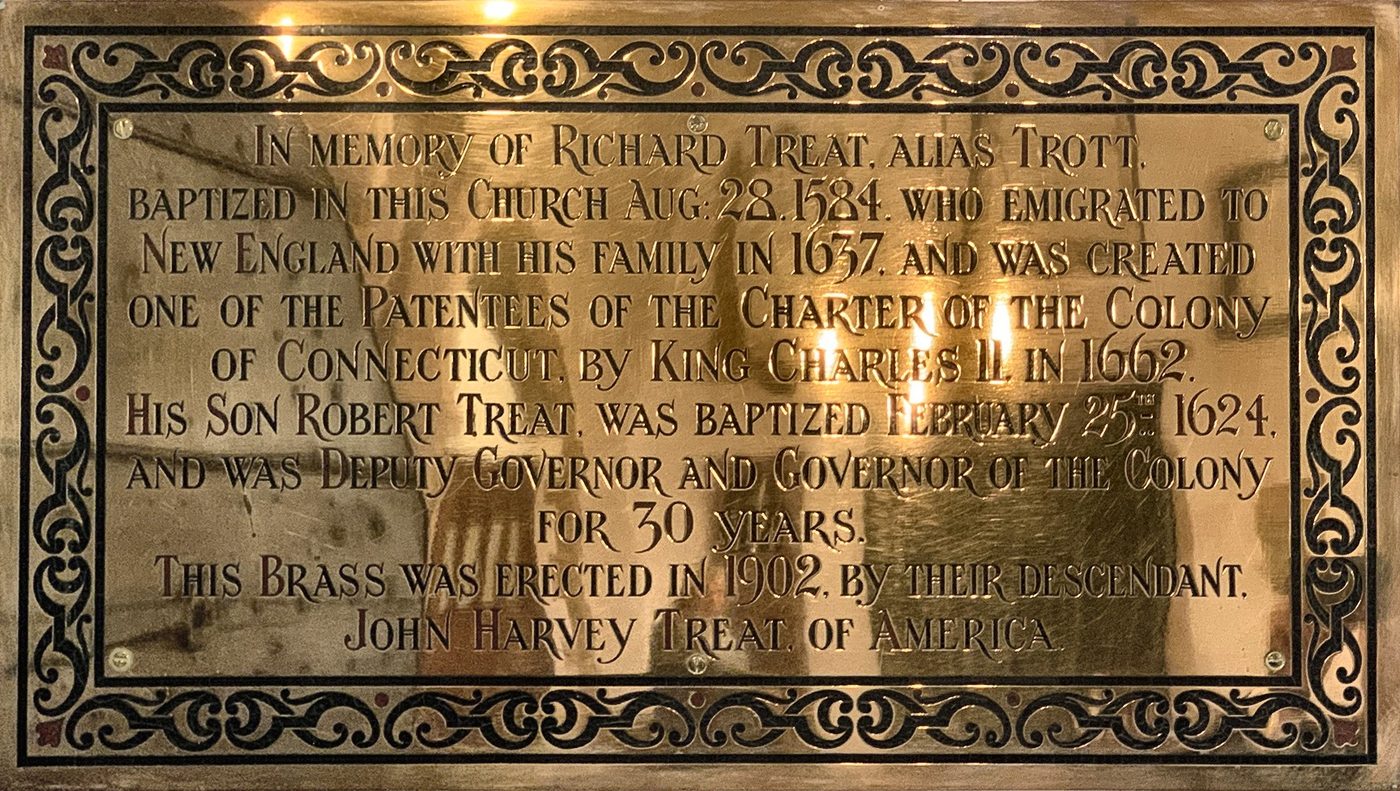
The family has been returning for a long time. John Harvey Treat came in 1902 and left the brass. When the east window needed replacing in the 1980s, American descendants of Pitminster families helped pay for it. In 2026 a party of Treats came to the church for a reunion, stood in front of the tablet, and walked the lanes their ancestor walked before the bells. If you are a Treat, a Gaylord, or descend from any family that left this parish, the family wall is yours; and if you have a record, a photograph or a story that belongs on this page, the editors would like to hear from you.
The family also tells its story as a game. Treatopoly runs the whole line around a board, from Set Sail 1637 to Return to Pitminster.